
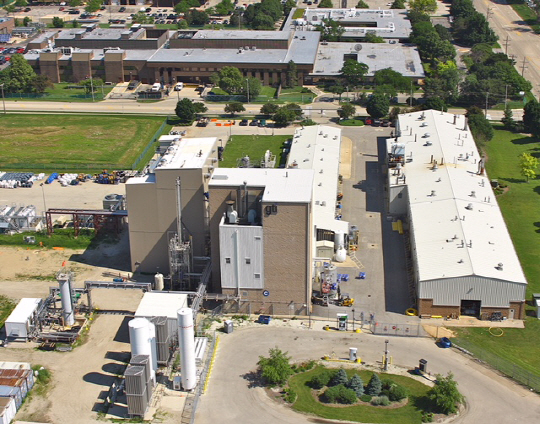
▲GTi Energy located in Desplanes, a suburb near Chicago.(GTI Energy)
“These are difficult questions to answer."
This is the first reaction this reporter got, as soon as sat down with Mr. Osman Akpolat, who reviewed prior questions.
Dr. Akpolat is a GTI Energy in Chicago, USA R&D senior project manager.
He has conducted research on various technologies in the field of energy conversion for more than 24 years, including CCS (Carbon Capture and Storage) technology.
Currently, He is managing industrial funded or U.S. Department of Energy related projects.
Before visiting the GTI Energy headquarters in person, this reporter sent preliminary questions by e-mail asking about the CCS strategy linked to Korea's geopolitical characteristics.
However, even GTI Energy, which can be called the 'front line' of CCS technology, can't easily answer these questions.
The topics are quite detailed and GTI Energy feels not in a position to offer an informed opinion without a significant investment of time in a more in-depth assessment for a variety of scenarios in a broad context.
This suggests the challenging nature of answering the questions for Korea.
In order to introduce CCS technology, several challenges must be overcome, and 'cost reduction' is considered as main concern.
Japan, which has relatively similar conditions to Korea, currently believes that costs must be reduced by at least 30%s from the present in order for CCS to be commercialized. (40% based on the Ministry of Economy, Trade and Industry in 2022)
Dr. Akpolat also said, “The views of the United States and GTI Energy are not very different from that number"
To this, he explained, technology development is being pursued with the aim of “keeping the same carbon dioxide (CO2) capture rate, reducing required energy and equipment-related costs."
However, it can be said that the conditions in Korea are particularly difficult.
With regard to cost reduction, the current global trend is divided into “two large stems."
First one is effort to increase technology efficiency Like GTI Energy, and second one is the creation of a “scale economy" that shares transportation and storage infrastructure between countries.
The first one is being promoted in connection with the so-called 'CCS developed countries' such as the United States, Australia, and Norway, while second one is being promoted in connection with the 'neighboring countries' surrounding them.
In Europe, the idea of transporting collected carbon by land and sea to North Sea coastal countries such as Norway and sharing storage is being drawn.
Norway's Northern Light Project and the UK-led North Sea Hub Project are representative.
In the Asia-Pacific region, where physical and institutional connections are limited compared to Europe, its own storage and sea transportation to Australia or Malaysia are planned as a “two-track."
Korea is also attempting a similar type of approach.
But, First of all, unlike Europe, which builds joint storage within the continent, efficiency losses from shipping, from Far East Asia to near the Oceania continent, are enormous.
minimizing overseas transportation and maximizing domestic storage in korea are also have difficulty about the shortness of the coastline, that is, its own storage capacity.
In fact, projects promoted at the government level have not yet been visible in Korea, except for the Donghae gas field.
CCS projects promoted by domestic private companies, like the Shepherd Consortium, are also being carried out based on overseas storage such as Malaysia.
On the other hand, Japan has selected five domestic regions, including northern Hokkaido, Tohoku, Niigata and the metropolitan area as candidates for the construction of CCS facilities at the government level.(And also two overseas regions, Malaysia and Oceania)
So we can say if Korea want to challenge the CCS cost target (possibly harsher) despite its geopolitical disadvantage, improving technology efficiency is particularly needed.
In response, this reporter asked GTI Energy, which is evaluated to be a few steps ahead of Korea in technology, about the history of CCS technology R&D.
And Particularly noteworthy was the background in which GTI Energy was able to take a relatively preemptive step toward CCS R&D.
“It has been more than 10 years since we first studied CCS from the purification of natural gas," said Dr. Akpolat. “Originally, our research on carbon dioxide separation began with natural gas purification and acid gas removal. so when the demand for carbon capture occurred, we were already in a position to start CCS work. because we had related equipment."
In cooperation with major international oil & gas companies, he said, “The relationship that has continued since our prior research in gasification and bioenergy has led to CCS R&D."
It seems that they were able to quickly advance into related new technologies with help of the stable and consistent performance of existing tasks.
“GTI Energy has steadily increased research and development on CCS over the past decade," Dr. Akpolat said. “carbon management is 50% of the total research and 25-30% of the CCS is selected."
The financial support to GTI Energy R&D seems also quite stable.
Regarding the sponsors of GTI Energy, Dr. Akpolat said, “In general, 33% of the government, 33% of local governments, and 33% of companies. they have similar proportions."
It was a rather unfamiliar structure for this reporter who had never heard of Korean case in which the central, local, and private sectors had steadily invested in specific field R&D for more than a decade.
For example, In 2022, the Ministry of Science and ICT cut the budget for the CCS project raised by the Ministry of Trade, Industry and Energy, through a preliminary feasibility study.
In Korea, the 'Ministry of Trade, Industry and Energy was in charge of CCS, and the Ministry of Science and ICT was for CCUS.
Of course, this reporter won't say that GTI Energy is completely free from financial risk.
When asked about the prospect of the GTI Energy CCS R&D proportion in the future, Dr. Akpolat took a cautious approach, saying, “I can't give you a specific answer."
despite the previous “steadiness of 10 years" in CCS R&D.
“As mentioned earlier, we are in a position to study with support from various places," he said. “If people's attention is suddenly focused on nuclear power, CCS can shrink."
Nevertheless, the CCS equipment identified along with him clearly showed the “next step" connected to the footsteps of the past.
(Link: Connected by equipment-related article.)

![“대출 막는데 집값은 왜 오르나”...한은이 주목한 ‘이것’ [이슈+]](http://www.ekn.kr/mnt/thum/202609/news-p.v1.20260910.12b4eb34f51c434f8a84e0e55aed2286_T1.jpeg)
![[금융권 풍향계] 수출입은행, 아프리카개발은행과 금융지원 활성화 업무협약 체결 外](http://www.ekn.kr/mnt/thum/202609/news-p.v1.20260910.f022bc546dd94393b1b3296e7cbd1333_T1.png)


![[AI시대 세미나] “직접 PPA 확대…전력구매자 신용위험 PF 새 변수”](http://www.ekn.kr/mnt/thum/202609/news-p.v1.20260910.72f69a6ff4fb47d793d8d9bef4bb6f22_T1.png)
![[AI시대 세미나] “에너지기업 AX, 규제 편입 가능성…거버넌스 체계·고도화해야”](http://www.ekn.kr/mnt/thum/202609/news-p.v1.20260910.c16eaeba7d694024bd2392ca464ee78e_T1.png)
![[AI시대 세미나] “전기가 국가 경쟁력 좌우…원전 추가, LNG는 브릿지로 활용해야”](http://www.ekn.kr/mnt/thum/202609/news-p.v1.20260910.d2af34953ad44a5f944b1e30712a8b65_T1.png)
![[AI시대 세미나] “메가프로젝트, 전력규제 대전환 요구…권역·사업별 세분화해야”](http://www.ekn.kr/mnt/thum/202609/news-p.v1.20260910.6a5cca419ddc44288a3cce34cb57c738_T1.jpg)
![[AI시대 세미나] 구글 딥마인드로 36시간 뒤 풍력발전량 예측…“성과 보상시장 만들어야”](http://www.ekn.kr/mnt/thum/202609/news-p.v1.20260910.f67faf8bfa5241f3aeca3c8c216bfa0f_T1.png)
;)